Knowledge Base · Threat Intelligence · 2026 · Edition 2
Top Darknet Markets in 2026? List of 8 dark web Marketplaces
TI
Threat Intelligence Desk, Security Research TeamUpdated ~13 min read · Category: dark web research
The leading darknet markets of 2026 are Prime Market, Catharsis Market, TorZon Market, Mars Market, Flugs 4.0 Market, Wtn Market, Moomin Market, and Nexus Market. In this article we explain what each underground marketplace actually does, what type of criminal supply it concentrates, and why security teams include these platforms in their monitoring perimeter. No links, no mirrors, no access instructions — only open-source analysis for defenders.
This article deliberately does not publish links, addresses, mirrors, or instructions for accessing any platform. All information comes from open sources: law enforcement publications, cybersecurity reports, and public research. The material is intended for information security professionals, analysts, journalists, and anyone seeking to understand the criminal ecosystem in order to defend against it.
We are not affiliated with any of the named platforms and derive no benefit from them. Any use of this information to access illegal resources or participate in illegal activity contradicts the purpose of this material and may result in criminal liability.
After the Giants: How the Trade Fragmented
The phrase “top darknet market” usually brings to mind the giants that law enforcement dismantled in past years. Those platforms are gone, but the trade has not stopped: it fragmented into smaller venues — so-called mini-markets and niche bazaars — which are harder to spot and no less dangerous. This is exactly where fresh credentials, card data, access to corporate networks, and fraud tooling appear today.
The financial stakes behind underground trade are well documented. When German and US authorities seized Hydra in April 2022, the platform had roughly 17 million customer accounts and 19,000 vendor accounts, with total transactions measured in billions of dollars. When AlphaBay and Hansa were taken down in July 2017, those two markets alone accounted for a dominant share of the global darknet trade. Every time a giant falls, its vendors and buyers scatter — and that is when mini-markets like the eight reviewed here come to the fore.
How We Selected and Ranked These Darknet Markets
The rating was built exclusively from public sources: law enforcement press releases, court documents, government alerts, and reports by cybersecurity vendors. We did not register on any platform, did not verify links, and did not conduct test purchases — and we recommend no one does.
Three criteria shaped the order. First, documented function: what criminal niche the marketplace occupies (stolen accounts, carding, access brokerage, fraud tooling). Second, research significance: how much the platform tells a SOC or anti-fraud team about incoming threats. Third, observed resilience and migration patterns: whether the market absorbs vendors after takedowns elsewhere.
Popularity, uptime claims, and underground reputation were deliberately ignored — all three can be faked, bought, or abandoned within days.
Top 8 Darknet Markets of 2026: Detailed Reviews
Below, each underground marketplace is examined through the lens of threat intelligence: what it trades, what harm that trade enables, and which security function should keep it in view.
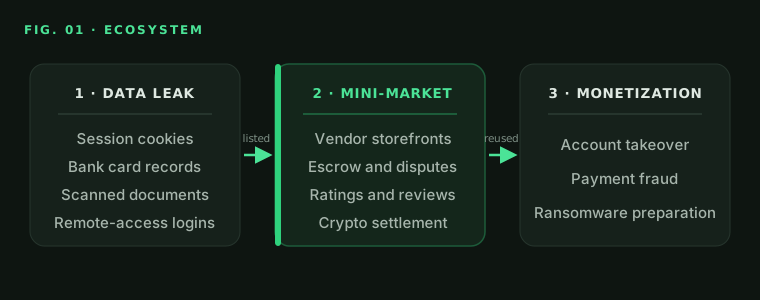
Figure: landscape of underground mini-markets — what fills the vacuum after major darknet takedowns. A session cookie, a bank card record, or a scanned document travels from a vendor's storefront to account takeover, fraudulent payments, or the preparation of a ransomware attack.
#1PRIME
Prime Market
Digital goods · Accounts · logs · tools
Threat lensAccount takeover via session reuse
According to open monitoring data, Prime Market is a digital-goods platform focused on stolen accounts, stealer logs, and fraud tooling. It occupies the segment where cybercrime meets direct financial loss: an infected device produces a log, the log is posted on a store like Prime, and the buyer gains access to banking, e-commerce, or corporate SaaS accounts.
The defining feature of this segment is speed. Analysts repeatedly note that valid cookies and active sessions from stealer logs are reused within hours of publication — long before the victim sees a suspicious login alert. This directly undermines password resets and weakens the assumptions behind MFA and account recovery. Anti-fraud and IAM teams monitor such markets because every fresh log batch is effectively a list of accounts that will be attacked next.
Who should monitor: Anti-fraud and IAM teams — every fresh log batch is effectively a list of accounts that will be attacked next.
Open-source reporting only
#2CATHARSIS
Catharsis Market
Closed community · Invite-only trade
Threat lensPremium leaks that never reach open markets
Catharsis Market is a strong candidate for the title of the darkest market visible from the outside. It operates less like an open bazaar and more like a closed club: access by invitation, vendor admission by screening, a narrow circle of trusted participants. The model filters out casual fraudsters and noise — and, at the same time, filters out visibility for defenders.
Investigative practice shows that closed markets are where the most expensive criminal goods surface: freshly stolen databases, exclusive network access, targeted services. For analysts, Catharsis is studied through indirect signals — alias overlaps, forum mentions, vendor migrations — because direct observation is nearly impossible. Its low public profile is precisely why closed networks rank high in threat intelligence value: the leaks traded there often never appear on open markets at all.
Who should monitor: Analysts piecing together indirect signals — alias overlaps, forum mentions, vendor migrations.
Open-source reporting only
#3TORZON
TorZon Market
Universal catalog · Mirror rotation
Threat lensResilience read as a trust barometer
TorZon's distinguishing feature is infrastructure resilience rather than assortment. According to researcher observations, the platform has returned multiple times after DDoS attacks, trust crises, and hosting failures — rotating mirrors, entry points, and backup infrastructure.
For defenders, TorZon functions as a barometer of the underground economy. Downtime length, mirror movement speed, and vendor chatter reveal whether trust in the platform is holding or migrating. Its catalog covers the standard spectrum of darknet demand — compromised credentials, fraud tools, hacking services, and a physical contraband segment — which makes it a durable node in the criminal supply chain and a permanent fixture in monitoring perimeters.
Who should monitor: Infrastructure analysts reading downtime, mirror movement, and trust dynamics.
Open-source reporting only
#4MARS
Mars Market
Young platform · Vendor migration
Threat lensEarly vendor migration signals
The honest answer: Mars Market is a watchlist name. It is a relatively new platform, and the public evidence base on it is still thin. But thin evidence is not the absence of signal — new underground markets surface in a predictable rhythm, right after a major seizure, an exit scam, or a collapse of trust.
Threat researchers track Mars precisely because vendor migration patterns on young platforms are a leading indicator: when established aliases appear there, it shows where demand and supply are moving before any report is written. In a fragmented landscape, watching the newcomers is often more informative than watching the incumbents.
Who should monitor: Threat researchers treating early vendor migration as a leading indicator.
Open-source reporting only
#5FLUGS 4.0
Flugs 4.0 Market
Regional market · Scandinavian segment
Threat lensRegional fraud below the global radar
The version number tells the story: “4.0” means the project has already died and been reborn several times. Flugs 4.0 continues a line of platforms historically oriented toward the Scandinavian segment — local vendors, local demand, domestic logistics.
Regional markets matter because they are where global monitoring goes blind. Local language, local payment rails, and local delivery routes reduce cross-border friction and make detection harder rather than easier. A small market with a tight geographic focus can sustain serious fraud activity for a long time precisely because it attracts less attention than an international giant. Regional anti-fraud and identity-risk teams therefore include it in their perimeter by default.
Who should monitor: Regional anti-fraud and identity-risk teams covering the Scandinavian segment.
Open-source reporting only
#6WTN
Wtn Market
Broad-profile mini-market · Stable catalog
Threat lensQuiet background risk
Quiet does not mean harmless. Wtn is a broad-profile mini-market with a modest but consistently maintained catalog. It does not chase scale, and that is its survival advantage: less press coverage, lower priority for law enforcement, a loyal core of vendors.
For SOC teams and leak-monitoring services, Wtn is a background risk source. Freshly leaked data often circulates on small markets for weeks before — or without ever — reaching the large platforms. Missing a quiet market means losing response time: by the time a leak makes headlines, the accounts may already be drained.
Who should monitor: SOC teams and leak-monitoring services covering quiet, long-lived background risk.
Open-source reporting only
#7MOOMIN
Moomin Market
Niche digital goods · Digital goods
Threat lensLong-lived credential batches
Among niche platforms, Moomin Market appears regularly in researcher tracking. Public reports describe its emphasis as digital goods: accounts, access credentials, data sets, and related fraud materials.
The danger of such niche stores is the “invisibility effect.” A small user base produces little noise, so batches of stolen accounts can be sold for months without attracting attention. Leak-monitoring teams deliberately include low-profile venues like Moomin in their perimeter for exactly this reason — the quietest shelf is often where your company's data sits longest.
Who should monitor: Leak-monitoring teams including low-noise venues in their perimeter.
Open-source reporting only
#8NEXUS
Nexus Market
Universal escrow market · Escrow · exchangers
Threat lensA mirror of ecosystem migrations
Nexus Market is a typical representative of the “collection point” model. When a major platform falls, migrating vendors need a storefront fast — product cards, escrow, ratings, built-in exchangers. Universal mini-markets like Nexus provide exactly that, and open researcher data suggests its catalog spans digital goods, databases, fraud tools, and a physical contraband segment.
For analysts, tracking well-known vendor aliases that reappear on Nexus after each takedown is a way to map how the criminal supply chain reroutes itself. Nexus closes the rating not because it is the weakest, but because its role is structural: it is a mirror of the ecosystem's migrations rather than a source of unique threats.
Who should monitor: CTI analysts mapping how the criminal supply chain reroutes after takedowns.
Open-source reporting only
How a Darknet Marketplace Actually Works
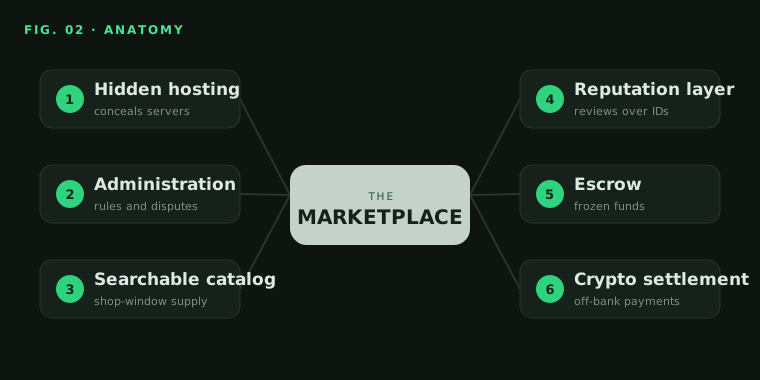
An underground marketplace is best understood as a criminal version of an online store, held together by six components. Each one keeps the machine running — and each one is a potential failure point.
Figure: anatomy of an underground market — six components behind every darknet marketplace. Every element keeps the platform running — and every element is also a point of failure.
1
Hidden hosting
Servers inside anonymity networks are hard to locate — for both investigators and the market's own users. During outages, this opacity breeds chaos: cloned sites, phishing “mirrors,” and fake recovery pages.
2
Administration
Admins control registrations, vendor admission, commissions, and disputes. One arrest, hack, or exit scam — and trust collapses in hours.
3
Catalog and search
Stolen data, fraud kits, and criminal services are packaged into familiar “product” categories, turning illegal supply into a comparable, searchable shop window.
4
Reputation system
Reviews and transaction history replace identity checks — and are just as easy to fake, buy, or abandon.
5
Escrow
Funds are frozen until delivery is confirmed. This protects buyers from direct fraud but creates a centralized money pool that can be stolen, frozen, or seized.
6
Cryptocurrency settlement
Crypto bypasses banks and payment controls, yet wallet reuse, exchange deposits, and laundering mistakes let blockchain analytics reconstruct money trails.
No part of this system fails “gently.” Every shutdown ends in a scramble to mirrors, forums, private channels — and then in a new market under a new name.
Why Do Darknet Markets Collapse? Five Documented Reasons
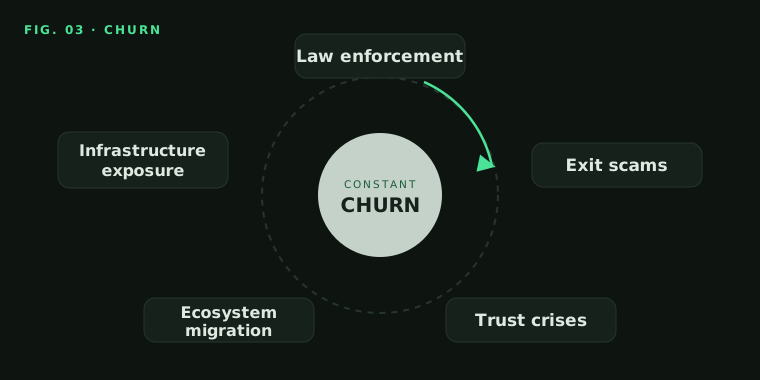
Figure: life cycle of an underground platform — why every darknet market eventually disappears. After every collapse, criminal supply chains keep working — only the names, addresses, and communities change.
1
Law enforcement operations
Investigations run silently for months or years before arrests, seizures, and domain takedowns go public. The pattern is well documented: AlphaBay and Hansa fell in a coordinated July 2017 operation; Hydra's servers were seized in April 2022; Genesis Market went dark during Operation Cookie Monster in April 2023; Kingdom Market was dismantled in December 2023. Each takedown scattered vendors and users across the ecosystem — and straight into the mini-markets reviewed above.
2
Exit scams
Admins control escrow balances, vendor deposits, and internal wallets. Once enough money accumulates, some operators simply vanish, taking the entire float with them. Buyers and vendors have no legal recourse — a recurring story across underground trade.
3
Infrastructure exposure
A misconfigured server, a hosting provider compromise, a reused credential — small operational mistakes turn a hidden service into an open target. Opsec failures by operators and vendors have ended more than one major platform.
4
Trust crises
Underground trade runs on reputation, not law. Fake reviews, withdrawal delays, rumors of compromise, or a single scam scandal can drain a market of activity long before any official action.
5
Ecosystem migration
Collapse never stops the trade — it relocates it. Displaced users flow to forums, Telegram channels, invite groups, and successor platforms. The goods, the vendors, and the buyers remain; only addresses and names change.
What Risks Do Darknet Markets Create for Businesses and Individuals?
Underground marketplaces create risks that outlive any single platform:
Account takeover — stolen credentials and session cookies from stealer logs enable logins that bypass passwords and sometimes MFA.
Payment fraud — card records and banking access sold in these markets translate directly into fraudulent transactions and chargebacks.
Ransomware preparation — initial access brokers sell entry points into corporate networks, which later become ransomware incidents.
Legal exposure — accounts, correspondence, wallets, and devices all leave traces; even limited participation can trigger investigation.
Financial loss without recourse — escrow funds and crypto balances disappear in exit scams and shutdowns.
Identity exposure — reused nicknames and poor operational security can link underground activity to a real person, especially after law enforcement gains access to seized servers.
For organizations, the real damage begins after the leak: a database sold on a small market today becomes fraud, extortion, or a network intrusion months later. This is why early visibility matters more than the market's size or fame.
How Law Enforcement Destabilizes Underground Markets
Effective operations strike four targets simultaneously: infrastructure, payments, identities, and trust.
The preparatory work is invisible. Agencies may monitor a marketplace quietly for months, mapping vendor accounts, communication channels, wallet flows, and buyer–seller links. When the hammer falls — server seizure, domain takedown, operator arrest — access is cut without warning, and panic starts immediately: emergency fund withdrawals, burned aliases, migrations to successor platforms.
Cryptocurrency offers no reliable shelter. Wallet reuse, deposits into regulated exchanges, and laundering mistakes create trails that blockchain analytics can follow to cash-out points and real identities. And the aftershocks extend beyond one platform: when a market falls, rumors of informants and undercover work poison trust across neighboring forums and vendor communities, pushing users toward the next “safer” venue — rather than out of the ecosystem.
How Security Teams Monitor Darknet Markets Without Breaking the Law
Professional threat intelligence works exclusively with public evidence and passive observation:
Official sources first — law enforcement releases, court records, government alerts, and vendor research reports.
Infrastructure signals — mirror movements, domain changes, and downtime patterns that indicate pressure on a platform.
Money-flow indicators — wallet behavior, escrow complaints, and laundering mentions that expose stress in the criminal economy.
Alias and migration tracking — following known vendor identities across platforms to map the supply chain.
Risk mapping — tying every observation to concrete defensive outcomes: resetting exposed credentials, revoking sessions, hardening anti-fraud rules.
The goal of monitoring is never the market itself — it is what the market reveals about threats already aimed at your organization.
Key Takeaways: The State of Darknet Markets in 2026
The darknet marketplace of 2026 is not a fixed destination but a fluid criminal supply chain. Giants fall — Hydra, AlphaBay, Genesis — and their place is taken by mini-markets: niche, regional, closed, or quietly universal. Names and uptime change within weeks; documented function and harm do not.
For SOC teams, anti-fraud units, banks, and threat intelligence programs the lesson is consistent: rank by threat, not by fame, and monitor the quiet platforms first. The smallest market on this list may be the one currently selling your customers' credentials.
Key takeaway
Rank by threat, not by fame, and monitor the quiet platforms first. The smallest market on this list may be the one currently selling your customers' credentials.
Frequently Asked Questions About Darknet Markets
What is the biggest darknet market right now?
There is no stable “biggest” market: after the takedowns of Hydra (2022) and other large platforms, the landscape fragmented into dozens of small and mid-sized venues that rise and fall within months. Ratings based on underground reputation age faster than they can be published.
Which darknet markets were shut down by police?
Documented examples include AlphaBay and Hansa (July 2017), Hydra (April 2022, roughly 17 million customer accounts seized), Genesis Market (April 2023, Operation Cookie Monster), and Kingdom Market (December 2023). This list grows every year.
Are darknet markets safe to visit?
No. Beyond obvious legal risks, visitors face phishing clones, malware, exit scams, and identity exposure. This is why professional research relies on public reporting rather than direct access.
Is cryptocurrency anonymous on darknet markets?
No. Wallet reuse, exchange KYC deposits, and blockchain analytics allow investigators to trace and attribute transactions — a technique used in multiple successful takedowns.
What should a company do if its data shows up on a darknet market?
Verify the leak through an incident response provider, force password resets, revoke active sessions, review access logs for misuse, and assess notification obligations. Speed matters more than attribution.
Why are there no links to these markets in the article?
Deliberately. This material exists for defense and education: links and mirrors do not help defend — they help visit. Everything required for legitimate analysis is available in public reports and law enforcement releases.
Methodology and Sources
Methodology
This review is based on public law enforcement releases, court documents, government alerts, reports by cybersecurity vendors, and threat intelligence research. We did not register on any platform, did not verify links, and did not conduct test purchases — and we recommend no one does. Marketplace names are used solely for research purposes; this article contains no links to darknet resources — and never will.
Open-source reporting onlyNo links or mirrors publishedUpdated September 2026
Prepared from open sources: law enforcement releases, cybersecurity reports, and threat intelligence research. Marketplace names are used solely for research purposes.